Monday, August 3, 2009

trigger happy

Cameras replaced sketching by the last century; convenience trumped engagement, the viewfinder afforded emotional distance and many people no longer felt the same urgency to look. It became possible to imagine that because a reproduction of an image was safely squirreled away in a camera or cell phone, or because it was eternally available on the Web, dawdling before an original was a waste of time, especially with so much ground to cover.
- "At Louvre, Many Stop to Snap but Few Stay Close to Focus" (NYTimes)
My biggest pet peeve: loud tour groups that crowd museums. That, and people who stand on the left on escalators. Don't even get me started.

The great thing about living in DC is that I don't feel the pressure to go through a (free!) Smithsonian in one visit. Realistically, based on my museum-going habits, I know that I will probably never actually make it back for a second visit or spend more than two hours in one museum at a time, but it's a nice thing to tell myself.

Whenever I bring my camera somewhere, though, I'm always torn between wanting to "capture" a moment, that I'll be able to look back on forever, or "experience" a moment, that I'll hopefully be able to remember forever. To me, art is about emotions and photos about feelings; they serve to frame both a moment and a mindset. But so often I find myself becoming guilty of simply being trigger happy, of living life behind the lens rather than in front of it, of collecting frames rather than experiencing moments, and of taking photos whose only purpose is to prove that "I was there."

Even if I wasn't really "there."

Friday, July 31, 2009

sugar and spice and everything nice

For those of you in the DC area: Tangysweet (which tastes exactly like Pinkberry) is now opening up another Red Velvet Cupcakery at their Dupont location, and they're giving out free cupcakes today starting at noon.

For those of you who drink Bud Light: apparently, so does Obama.

And in honor of it being exactly one week (7 days! 168 hours! 10080 minutes!) until my 21st birthday: here are 17 of the worst shots ever created. Scroll down to see my personal favorite from this summer: the Four Horsemen (Jim, Jack, Johnny, and Jose).

an american in paris


Yesterday I went to a free sneak preview showing of Nora Ephron's Julie & Julia, which will be released Aug. 7. Based on the true life stories of Julia Child (Meryl Streep), the beloved cook (and spy?!) who wrote the 734-page book Mastering the Art of French Cooking, and Julie Powell (Amy Adams), the Lower Manhattan Development Corporation employee turned blogger turned writer, the film weaves together Child's memoir My Life in France with the creation and carry-through of the Julie/Julia Project.

It's no secret that the real star of the movie is the food (even The New York Times wrote about it in its article "Film Food, Ready for Its 'Bon Appetit'"), but Streep is pretty flawless herself as the eccentric, larger-than-life, and lovable chef. Both her and Adams, who sports an androgynous haircut in place of her normal red waves, pass the hardest test of playing a real person: believability, although both women do seem to have unnaturally perfect marriages and Adams appears to have an unnaturally fast metabolism given all the butter she claims to use. While the film drags on a bit towards the end, making it seem longer than the 123 minutes it actually is, for the most part the plot is engaging, the writing entertaining, and the comedic timing on point (but what else would you expect from the director of When Harry Met Sally and You've Got Mail?).

The only downside: a strong craving for rich French food immediately following viewing.

Friday, July 24, 2009

three gray walls and a dell

"I don't think a pre-born child is yearning for anything. Douche."
- our lobbyist
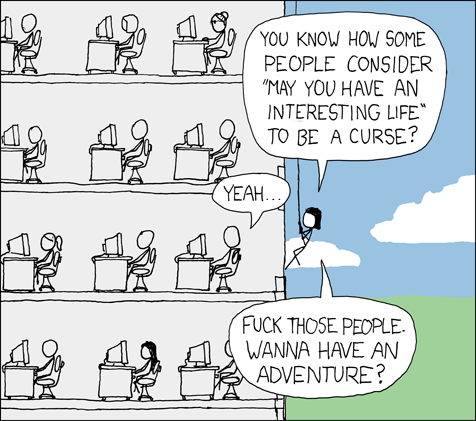
I love the people I work with, but most of the time I feel like the cubicle is sucking my soul out. I'm dying to be outside, moving, exploring, but instead I'm stuck in a 6 by 6 cell, without even a window to longingly look out of.

why journalism will never die